Personal Branding – How-to Avoid Brand Name Confusion

Personal Branding is all about earning your brand the attention it deserves; but what if your brand shares the spotlight with someone else? In other words, what if you have a common name?

If the next employer, or client, or contact googles your name up to learn more about you after that brief encounter at the business cocktail you attended last week, will they find you, or someone else with your name. What if that person they found has digital dirt, how does that affect the future of your relationship? You might lose the job, or the business, or that opportunity …

Let’s take an example … two of my students introduced themselves as Ahmed Kamal. I found 447 results on LinkedIn called Ahmed Kamal! Now what are the odds of anyone finding you amongst that list? Let’s just be optimistic and say VERY SLIM!

John Antonios - How-to Avoid Brand Confusion Image

John Antonios - Brand Confusion - (Photographer: Astrid Challita)

You need to make sure your brand name is not confused with someone else’s and here’s how you go about doing that:

Change THE NAME

Chances are Ahmed Kamal won’t go to the official register and change his name … so that’s not the change I’m talking about here. I’m talking about adding uniqueness to your name. Here are some options:

  1. Add a key identifying factor: Associate your name with a title, an adjective, a profession; for example: Ahmed Kamal, MD or Ahmed Kamal, The Painter or The Great Ahmed Kamal … ok maybe you shouldn’t consider that last option, it might be attributed to a narcissistic tendency, unless that’s how you’d like to brand yourself, then by all means, go ahead!
  2. Nicknames: I never understood why everyone in Egypt had a nickname, but then I realized that this is the only way people can identify who they were referring to, since they all share very common first and last names. A tip on using a nickname though, make sure it’s not offensive in any circle. I have a friend that I’ve always known as Moë Ash – I recently tried to add him to my LinkedIn professional network, and I couldn’t find him. Then I discovered that his real name is Mohammed Reda … so when I conducted the search on that name on LinkedIn, as expected, I found one too many results. So my advice to him was to add his nickname to his real name, and introduce himself in any network as Mohammed Reda better known (or also known) as Moë Ash.
  3. Mix it up with initials: Sometimes all you need to do is use initials – A great example on that front is my friend Christine L Bowen, who uses CLB as an acronym for her name and she also translates that into her brand attribute (Create, Live, Be).

COMMUNIcate the same brand name

Regardless of the option you end up choosing for making your brand unique, make sure you communicate that same brand name across all platforms, online and offline.

  1. Own the name – or what I like to refer to as e-real-estate. Purchase your brand name url … www.yourbrandname.com 
  2. Social Networks synergy - use the same brand name on all your social networks – have a look at this free tool www.namechk.com – it allows you to check the dominance of your chosen brand name (which should be your username) on multiple networks.
  3. Offline Material – be it your business card, your CV, or your signature, or any other kind of introduction (even an oral one) … make sure you communicate your brand name as you would like the receiver to remember it and search for it (for further reference)

drown the competition

You can never delete a search result from Google, but you can certainly drown it. In other words, you can make sure that result, which you want to hide, does not show up in the first three pages of Google. That can be achieved by owning your online brand name, as explained in the above section, and by being active in the different platforms and adding valuable content.

Here are some ways you can do that:

  1. Blog & Share: if you want to get noticed by your next employer or client, you need to make you are share you knowledge, thoughts, reviews about the industry (brand or product) on your blog. You need to make sure that the keywords you wanted to be associated with are frequently used on your blog.
    Needless to say, I’m talking about blogging, as a certain prerequisite to any online brand. Think of the blog as your main brand communication hub, which can be reached at www.yourbrandname.com
  2. Commenting on high traffic blogs: A great way to get noticed in the online community is to leave smart comments on high traffic  blogs. Notice, I said “smart” comments … you want to make sure the comments you leave behind arouse the interest of the reader enough from him or her to link back to you and check your profile, or blog … technically, you rank higher in Google when you have more incoming links. All comments will be signed off with your brand name
  3. Brand it: sign everything you share online with your brand name. If you upload a picture or an infographic that you created, make sure your brand name is there on the image, and in the name of the file you upload.

Now go on, google your name? are you happy with the results? how many you’s are there? Does your name appear in the first 3 results? How many time does  your brand name recur on the first 3 pages? now be honest, if you didn’t know you, could you tell which you is YOU? Confusing, I know, this is exactly how those seeking you out feel! Think About It! 

KLOUT – Measuring Your Personal Branding Influence & Style

There are thousands of Social Media monitoring tools out there that should certainly be used to measure the effectiveness of your branding activities. This here is the first in a series of posts that will be introducing how to make the best use of these tools. In today’s post, I’ll be talking about the benefits of Klout and why I believe it’s an indispensable personal branding monitoring tool.

PS. Before you go on with this post, make sure you signup for Klout using your twitter account, and have it open in a separate window, as I will be reverting to it several times during the course of this post.

What is Klout?

In short, Klout is tool used to measure and leverage your online influence based on your use of social media communication tools like Twitter, Facebook, LinkedIn, Foursquare, and Google+. Wherever you have an online presence, you have the opportunity to influence people by creating or sharing content that inspires actions such as likes, retweets, shares, comments and more. The more engagement your posts receive, the more influential you are. Tracking this influence overtime, allows you to understand your brand resonance further, and basically, highlights what you should continue you doing, and what you should refrain from exploring.

What does you Klout score measure?

John Antonios - Understanding Klout - Score

Figure 1 - Klout Score

Klout gives your influence a score from 1 to 100. This score is calculated based the level of your social media engagement, so make sure you connect all your social networks and use them properly to score higher. Here are some attributes that go into the calculation of your score:

  • Facebook – likes, comments
  • Twitter – retweets, mentions
  • LinkedIn – comments, likes
  • Foursquare – tips, to-dos, done
  • Google+ – comments, re-shares, +1

It’s also important to mention that the average Klout score is 20 (not 50). The higher you score, the more difficult it becomes to add points to your score.

The score itself is not as important as the trend presented by the historical data. In Figure 1, you’ll notice that my current Klout score is approximately 56. The drops showcased in the graph highlight my period of extended inactivity. Note that this score is updated on a daily basis based on your activity. You should aim at having a positive sloped graph.

Having a large number of followers or likes or whatnot is not what counts towards your Klout score – it’s the level of engagement with your audience that matters. So basically, it’s not the size of your network, but how you use it to inflict action!

What are you influential about?

This feature of Klout is of utmost importance.

According to William Arruda, the 3Cs of Personal Branding are Clarity, Consistency, and Constancy. Being a Jack-of-all-trades is not exactly the best approach to personal branding – in fact, I’d highly advise against being one. Your aim is to be known for something not everything. Gone are the days where a generic approach is plausible; you should aim at developing a certain level of expertise, and target a specific audience!

Klout monitors your social media activity and analyzes what topics you’re most influential about. In Figure 2 – you’ll notice that I’m personally influential about Personal Branding and Social Media – this is perfectly aligned with Personal Brand objectives.

John Antonios - Understanding Klout - Influential Topics

Figure 2 - Klout - Influential Topics

Have a look at your influential topics, are the top 5 topics analyzed by Klout representative of your brand? If the answer is “No”, then you might want to reconsider what you’re putting out there!

What is your Klout Style?

This is by far my favorite Klout feature!

Klout has developed a great matrix to help you understand your social networking style. This complex matrix measures your style of engagement (Listening, Participating, Sharing, and Creating) and your content (Broad, Focused, Consistent, and Casual). This in turn forms 16 different styles as depicted in Figure 3. For further description about each style, make sure you look at this interactive graph (just hover the different section of the matrix and learn about each style).

Klout Style Matrix

Figure 3 - Klout Style Matrix

You want to completely avoid being in the lower left quadrant! If your personal brand lies in that corner of the Klout matrix, you should start engaging with your social network and be more active. Depending on your brand attributes, you might choose to go towards the right of this graph by being more focused in terms of topics discussed, and consistent in delivering it. Or you may choose to move vertically up if you are more in the spirit of sharing information you come across with your followers. Finally, you may choose to move diagonally upwards, which more often than not requires of you to have an pre-existing imposing brand (like a celebrity would). People like Lady Gaga & Barak Obama occupy the celebrity corner – basically, what this entails is an audience that hangs on every word and probably retweets the hell out of anything they post, but they (Gaga & Obama) rarely (more like never) make it a two-way conversation.

However, I strongly recommend you focus on having your personal brand in the lower right quadrant of the Klout matrix. Being a specialist means that within  your area of expertise your opinion is second to none. Your provide focused content around a specific topic or industry and share it with a highly engaged audience. This is the kind of fame you need to attract towards your brand – “earned fame” not a bought one!

Additional klout features

Aside from all the great features discussed above, Klout scores your:

  • Amplification – how much you influence people
  • True Reach – the number of people you influence, both within your immediate network, and across their extended networks.
  • Network – how influential is your network

Klout also allows you to compare your different scores – this feature allows you to benchmark your social media engagement against your competition and therefore enhance your online performance.

This brings us to the end of our Klout discussion for this post. Whatever you are doing to communicate your brand, make sure you are measuring your progress and setting goals, otherwise, your efforts might go unnoticed, and that would be a shame. Think About It!

As I mentioned at the beginning of this post, I will be publishing a series of articles to help you better manage your personal brand – so make sure you subscribe to my blog or to my RSS feed (http://johnantonios.com/feed) to your favorite reader (eg. Google Reader)

Do you use other tools to monitor your personal brand? If so, why don’t you share them in the comment section below …

Grow by Saying “NO”

I know the title of this blog post might throw off my regular reader (since I’m always preaching about being positive and having the affirmative attitude towards life), but before you jump to any conclusions, I want you to realize that the outcome of saying “NO” is a positive one!

When I started my consulting practice, I was hungry for business, I wanted to knock on every door, answer every RFP, take all the calls, cater to every workshop, … basically, I wanted to do everything all at once! Don’t worry, I didn’t lose that hunger, nor am I asking you to be any less passionate about your business – all I’m saying is that in order to grow, sometimes you have to say “No”.

How so? The answer is quite simple – think of the scenario where you end up saying “Yes” to every request … aside from the obvious overwhelming factor that you’re most likely to experience, what is the probability of delivering each request at the perfection it deserves? In my opinion, it certainly is much lower than the probability of having your energy poured into a manageable handful, right? So basically, if we follow that chain of logic, then turning down a couple of requests, and focusing on delivering a perfect turnkey solution in a handful, would certainly lead to future referrals, and hence grow your business. So saying “No” actually results in your business to grow.

However, saying “No” is not a mere gut feel – it’s actually a calculated “No”. Here’s my recommendation when it comes to deciding whether or not to take on a project:

STep 1 – CHECK WITH YOUR “VALUEs” COMPASS

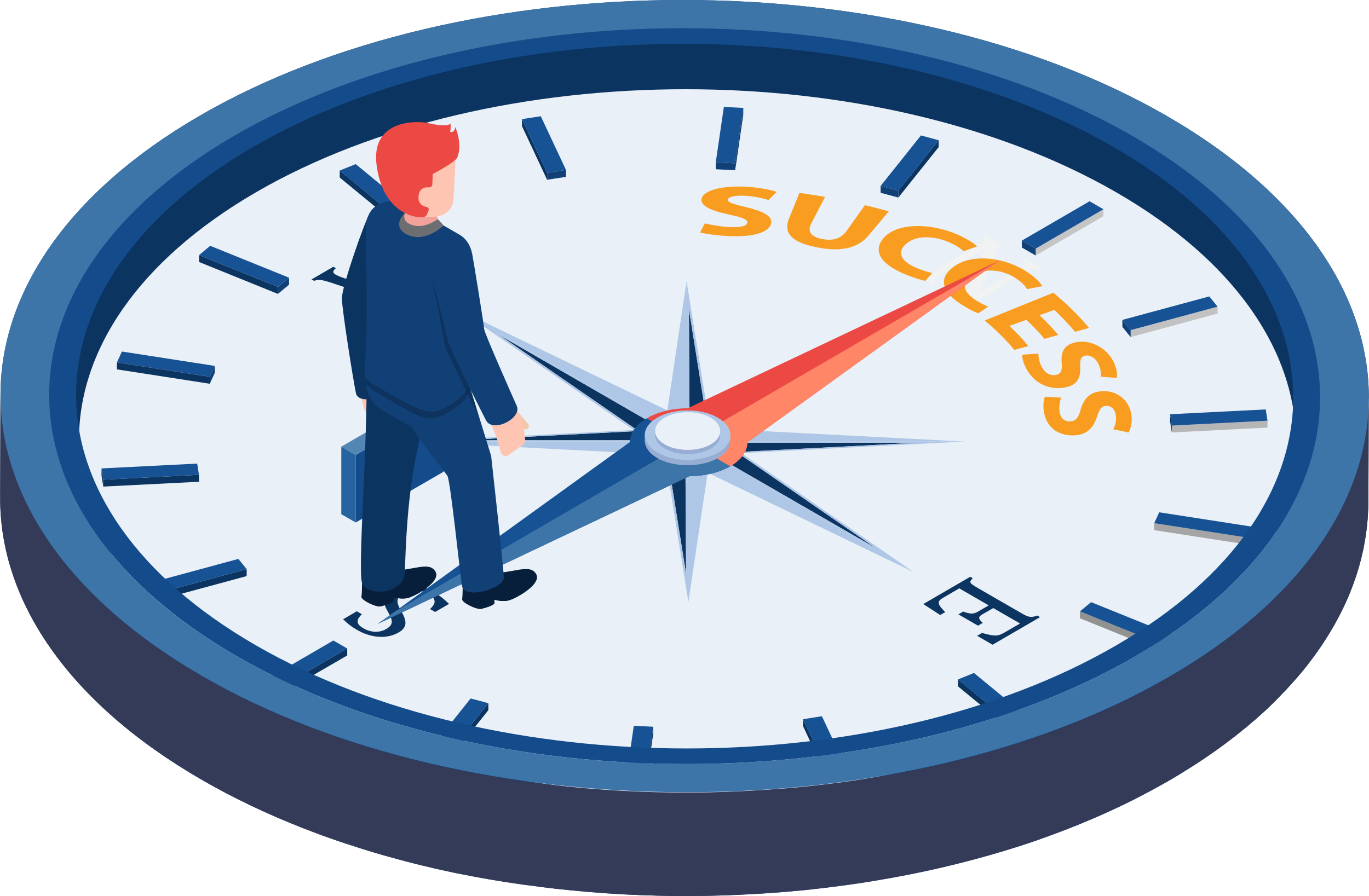
Your personal values act like a compass in deciding whether or not to engage in a certain endeavor. Defying your values would certainly result in some sort of personal compromise … and that is against my personal branding principles.

The list of personal values is endless, but let me give you an example to elaborate on this recommendation. Suppose “family & friends” are on top of your value list, and the opportunity presented to you requires you to spend a whole year on an oil rig in the middle of the ocean. True, the financial compensation will probably be substantial, but the question is, “at what expense?”

Ok maybe I was too sentimental in my previous example, so let’s look at a more pragmatic one. Suppose “equality and fairness” are on top of your personal value list, and in the establishment you’re employed in, the managing director is randomly firing people with no just cause. Would you stay? Bearing in mind that you are really pampered in this company? and at what expense?

If the opportunity passes the value test, move to step 2.

Step 2 – SET & PRIORITIZE YOUR GOALS

Now that you got the value aspect covered, you need to make sure how the project you’re saying “Yes or No” to fit with your objectives. Needless to say, the extract phase of your personal brand clearly highlights that you have to lay down your SMART goals, for ”A person who does not have goals is used by someone who does!”

So think of the opportunity presented to you: Does it really serve your purpose?Will it help you reach your goals faster? Does it divert you away from your destination? According to your prioritized goals, does this proposal come in too soon? Are there things you need to tackle before engaging yourself in such a step?

If the opportunity is aligned with your personal goals, proceed to step 3.

Step 3 – Measure the constraints & calculate the consequences of a new project

In any project, you need to look at three constraints: Scope, Resources, and Time. Can the constraints of the project be met? At what cost? Will it jeopardize the progress or delivery of another project on hand? Will I be removing resources currently dedicated to an existing venture to serve the new one?

If you pass step 3, then by all means, say “YES”, but if you fail at any step, and you plan is to grow, then know that you should say “NO” – Think About It!

When was the last time you said “No”? How did you come about that decision? Do you regret it? It would be great if you could share your personal experience with me!

Personal Branding – GEMANALOGY – A Diamond in Rough

You are a “Diamond in the rough” – first time I had heard this expression was in one of Disney’s great classics, Aladdin (1992).  I was only 12 then, but the context of the expression really inspired me to inquire more … here’s what the merchant trying to sell Aladdin the magic lamp told him …

Do not be fooled by its commonplace appearance. Like so many things, it is not what outside, but what is inside that counts. This is no ordinary lamp. It once changed the course of a young man’s life. A young man, who, like this lamp, was more than what he seemed. A diamond in the rough.

The phrase is metaphorical and relates to the fact that naturally occurring diamonds are quite ordinary at first glance, and that their true beauty as jewels is only realized through the cutting and polishing process (Urban Dictionary).

The process of Personal Branding is very similar to the different phases that a gem goes through before becoming the jaw dropping stone we have to be dragged away from before we start drooling … This analogy was first introduced by William Arruda, President of Reach, and coauthor of Career Distinction, one of my all-time favorite Personal Branding books. However, I took the liberty of coining the term GEMANALOGY, not to be confused with gemology, which in our given analogy only serves as the first phase of our Personal Brand, where we get to learn more about our brand.

GEMANALOGY has three 3 interdependent phases: Extract, Express, Exude … noticeably the three words commence with EX, referring the importance of the External perception of our gem!

GEMANALOGY by John Antonios

Phase 1 – Extract

Just like any gem, our brand needs to be discovered – extracted from the ground, carved out of the rocks … this requires dedication and patience! This where you get to know yourself … your vision, purpose, goals, passion, values, brand attributes and skills, and much more … I won’t be addressing how to go about discovering all of those in this post, but I’ll address the topic of Passion

So what is passion? and how can you really find out what you’re passionate about? I’ll tell you one thing, it’s not easy, nor can it happen over night … here’s a helping hand though:

What fascinates you?
What excites you?
What turns you on?
What gives you a rush?
What could you go on talking about for hours?
What would make you get out of bed at 6:00 am?
What would keep you up all night?

These question should help steer you in the right direction. However, since we’re talking about cashing in on your passion, the aim is to do just that … therefore, I want you to think of your passion under that pretext. What would you do if you had all the money in the world? The format of this question, eliminates money from being an obstacle, and allows you to to truly think of aforementioned questions without bias.

If you’re keen on understanding your brand in depth, I would highly recommend you take the 360°Reach™ FREE Personal Brand Assessment. Let me know if you’d like to move beyond the free version!

Phase 2 – Express

After extracting your priceless stone, it’s time to cut it, polish it, and let it shine! This is the express phase of Personal Branding. In this stage of our GEMANALOGY, we should start developing our Personal Brand Marketing toolkit … your brand statement, bio, colors, CV (if you insist)elevator pitch and much more! Express is all about communicating your brand to the people that need to know about it.

Personal Branding is clearly communicating the unique promise of value that you offer. William Arruda

Communicating your brand is not a random act. It should be a comprehensive well developed plan that best serves the goals your laid out in the Extract phase.

Phase 3 – Exude

After unearthing your gem and giving it the cut and polish it deserves, it’s time to mount it onto the ring, the earring, the necklace … basically showcasing it to your intended audience. This phase is better known as Exude phase, where you abundantly exhibit your personal brand.

Be your brand in everything that you … remember Personal Branding is full-time lifetime job. Unless you suffer from MPD, there’s only one you – so make sure you remember that!

In our analogy, the ring, earring, or necklace are what we call the visual elements that support your brand … be it your logo, slogan, your physical appearance, your environment … yes, your environment … everything the you surround yourself with should reflect your brand and its attributes. For example, imagine you’re brand is all about fashion,  and you dress like rag … does that emit confidence to you? I don’t think so …

The number one secret of earning attention is giving it – it’s BRAND KARMA …

It’s a new year, a time for resolutions – make your legacy that of this year’s! Think About It!

Lizard Brain – Shut the F*** Up!

Why do we insist on thrashing when we’re so close to shipping? Why is it easy to always find excuses? Why do we procrastinate? Why do we sabotage our own success? Well, the answered is wired into our system – literally so – It’s our Lizard Brain, also known as the Amygdala, or the reptilian brain!

The Lizard Brain - John Antonios

The amygdala operates behind the scenes, regulating our survival needs: food, oxygen, heart rate, blood pressure and reproduction. It is also responsible for our fight or flight reflex. It’s been described as your personal bodyguard, always scanning your surrounding environment for potential threats. So why on earth would I want to shut it up?

I think of the Lizard Brain as more of an overprotective parent, who won’t let you ride the bike because you might end up hurting yourself. It’s the part of your brain responsible for your fear, anxiety, and negativity. The Lizard Brain hates my to-don’t list, cause that’s like its credo. The closer we get to shipping, the louder the cries of the Lizard Brain. I’m certain you’ve heard it before, actually, you hear it more than once every day – it goes something like this:

Don’t quit your job, where would you get money from?

Don’t go up on stage, they might laugh at you!

Why don’t you take a nap now, it can wait … don’t worry about!

You have to keep your ego at the door, try to blend in more …

How many times do you need to fail to understand that you’re just not cut out for it … give up already!

They told us to follow the instructions to the letter … I wouldn’t recommend you do try that!

Start a blog, why would you do that … who’s going to read anyway?

Dancing, that’s not a profession, are you kidding … if you want respect in society, you need to be a doctor or an engineer … not a dancer, get real man!

You want to quit practicing medicine to pursue cooking as a career … have you completely lost your mind?

If people ask you what it is that you do, are you seriously going to tell them you’re a photographer … that’s a hobby man, not a profession, go find a job!

And the list of excuses goes on forever … we all do it – I’m certainly guilty of doing it often too, but they say, acknowledging the problem is the first step in solving it, so how do we do that? Before I answer that question, let’s first highlight the tactics used by the Lizard Brain to sabotage of success:

  • Procrastination
  • Being overly critical of our work
  • Invent Anxiety
  • Obsess over details
  • Create Excuses

Identifying the tactics allows us to recognize early on a strike by the reptilian brain and build up a defense against it. Here are some of the ways you can silence the lizard brain:

  • embrace failure and learn from it - Allow yourself to have bad ideas – see the thing with ideas, it’s not hard to come up with them, the hard part is doing something about it … don’t worry about it being the perfect planned idea, most of them aren’t, but you’ll never know until you ship. So what if it fails, you’ll come up with another one, and another … most successful people today have failed one too many times before they made it!
  • do something you would have never thought of doing? get up in front of a group of people and sing (even if you can’t, actually specially if you can’t) … or take something you have at home and try to sell it to someone, and see how it makes you feel, note down what you learn about yourself in the process … surprise yourself, you might actually like it!

In short, I would recommend that you do everything your Lizard Brain tells you not to do …

More often than not, the negative results of a “What if” scenario are far less than positive outcomes. Here’s only one example, of which I have many:

You’re in an elevator, your boss is there, you have this idea that you wanted to share with her … your lizard brain tells you to shut up and go to your office and let the day go by without embarrassing yourself … do the complete opposite to that, tell her about it – what’s the worst that could happen? She might completely ignore the idea, or laugh at it? Now, think of the magnitude of positive outcomes that might come out of it – she might tell you to schedule a meeting to discuss it further, she might ask you to prepare a study and present to the board, she might ask you to join her for lunch to discuss it with the partners … and so man more possibilities!

The Lizard Brain sabotages your success by camouflaging itself with logic – tell it to Shut the F*** Up!

Think About It!

Book & Article Recommendations on the Subject: