Six lenses to explore what holds you back – and choose whether, when, and how to speak.
Conflict avoidance can be difficult to understand because the same decision—to stay quiet—may reflect very different concerns.
You had a concern. You considered raising it. Then the moment passed.
Looking back, you might explain it with a single sentence: “I didn’t want a confrontation.” But that sentence leaves a lot unexplored. Were you protecting a relationship? Responding to a power difference? Missing information? Struggling to find the words?
The distinction matters because the next useful step depends on what influenced the choice. Rehearsing a sentence might help someone who knows what they want to say. It will not, by itself, remove a credible risk of retaliation.
I developed PAUSER as a coaching reflection framework for exploring those moments. It offers six lenses: Peace, Authority, Uncertainty, Self-belief, Expression, and Relationship. A coach can use it as an inquiry guide; a coachee can use it for personal reflection.
PAUSER is an original coaching tool, not a validated diagnostic assessment. Its categories are proposed distinctions, not established independent factors. More than one may apply, and some reasons will sit outside them. The purpose is to support an informed choice about whether, when, and how to engage.
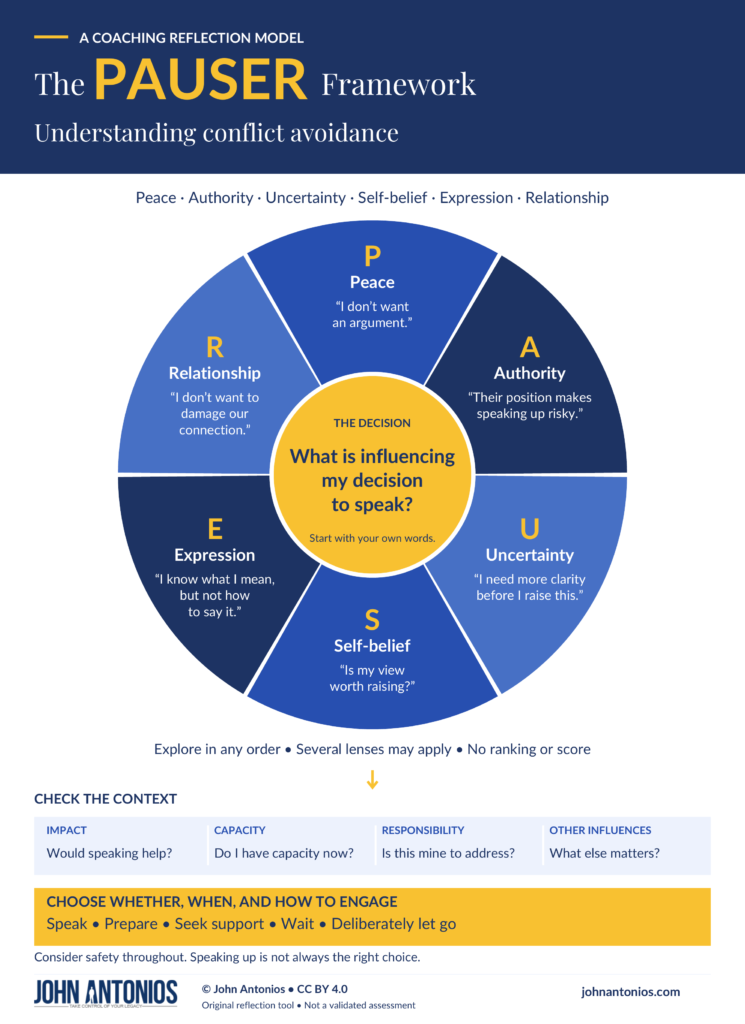
The PAUSER Framework by John Antonios. Explore in any order; several lenses may apply. Graphic licensed under CC BY 4.0.
Understanding conflict avoidance: begin with your own account.
The acronym provides a way to remember the lenses, not a sequence you must follow. Explore in any order. The circular model places the decision to speak at the centre; its equal segments do not indicate measured importance or scores.
Choose one specific moment rather than starting with “I’m conflict avoidant.” Ask: “What did you want to say, and what influenced your decision not to say it?”
Let the person answer in their own words before introducing the categories. A checklist can help someone recognise an experience, but it can also lead the conversation if we offer explanations too quickly. Use PAUSER to open possibilities, and let the person reject any lens that does not fit.
P — Peace
“I don’t want an argument.”
Peace concerns the immediate friction of the exchange: tension, disagreement, disruption, or the prospect of a conversation expanding beyond what you intended.
Ask: “What immediate friction were you hoping to avoid?” You might then explore what a manageable exchange would have looked like.
Peace and relationship are different. “We will be fine tomorrow; I just don’t want an argument tonight” differs from “We could speak calmly, but I worry they will stop confiding in me.” The first concerns the exchange; the second concerns the continuing connection.
A — Authority
“Their position makes speaking up risky.”
Authority concerns power and its possible consequences. That can involve formal seniority or informal influence over opportunities, reputation, access, or belonging.
Ask: “How did their power or influence affect your choice?” Follow with: “What consequences did you anticipate, and what experiences informed that expectation?”
Do not automatically translate a power concern into low confidence. Someone can trust their judgment and still face meaningful consequences for expressing it. A useful next step might involve support, a different setting, an appropriate alternative channel, or choosing not to engage.
U — Uncertainty
“I need more clarity before I raise this.”
Uncertainty covers two possibilities worth distinguishing: genuinely missing information and difficulty proceeding while something remains unknown. Neither should be presumed from the phrase “I need more information.”
Ask: “What remained unclear, and what did you need to know?” Then: “What specific information would change your next step?”
Sometimes the responsible choice is to find out more. Sometimes there is enough information to raise a question, even when there is not enough to reach a conclusion. The coach’s task is to help explore that distinction without pushing the person toward a predetermined answer.
S — Self-belief
“Is my view worth raising?”
Self-belief concerns confidence in the value or validity of your contribution, including whether you feel entitled to offer it.
Ask: “How were you judging your own perspective?” Explore both what supports the view and what challenges it.
The boundary with uncertainty is useful: “I don’t have the relevant figures” concerns missing knowledge; “I have the figures, but perhaps someone like me shouldn’t question the conclusion” points toward self-belief, possibly alongside authority. The goal is a fair appraisal of the contribution, not uncritical reassurance.
“Worth raising” needs a follow-up. Do you doubt the value of your contribution, or do you expect that nobody will act on it? The first points toward self-belief. The second concerns expected impact, explored in the context check. Someone can believe their concern is sound and still reasonably expect it to be ignored.
E — Expression
“I know what I mean, but not how to say it.”
Expression is the assertive-communication dimension: putting a concern, disagreement, request, or boundary into words clearly and respectfully.
Ask: “What did you want them to understand?” Then explore where finding or delivering the words became difficult.
A possible opening is: “I see a risk in this approach. Could we look at it before deciding?” Another is: “I’m missing some context. Can we check one assumption?” These are starting points for rehearsal, not scripts that guarantee a good response. Clear wording cannot eliminate every interpersonal or power risk.
R — Relationship
“I don’t want to damage our connection.”
Relationship concerns ongoing trust, closeness, acceptance, or cooperation.
Ask: “What about the relationship were you protecting?” It may also help to ask what continued silence could mean for that relationship.
Someone may want to preserve a connection without fearing an argument. Someone else may tolerate disagreement but fear exclusion afterward. Explore the person’s meaning rather than assuming all relationship concerns are the same.
Check the context
PAUSER is deliberately not an exhaustive account of silence. Before moving to action, explore context:
-
- Impact: “What difference did you expect speaking to make?” A person may be confident, articulate, and safe, yet expect no response.
-
- Capacity: “What capacity did you have for this conversation then?” Exhaustion or emotional overload is not identical to wanting peace.
-
- Responsibility: “How did you see your role in addressing this?” A boundary or a judgment about relevance may explain the decision.
-
- Other influences: “What else mattered that we haven’t named?” This keeps the person’s experience larger than the framework.
Safety deserves attention throughout, not only when the Authority lens is selected. A coach should not encourage confrontation simply because it looks like progress on a worksheet.
Choose whether, when, and how to engage
Ask what staying quiet protected and what it cost. Consider possible consequences of speaking as carefully as those of remaining silent. Distinguish what actually happened from what was anticipated, without dismissing anticipated risks.
Then identify realistic options. These might include speaking now, preparing, gathering information, choosing a private setting, seeking support, waiting, or deliberately leaving the issue alone. If the choice is to wait, identify a date or event that would prompt reconsideration.
Afterward, review: What did you choose? What happened? What differed from your expectations? What would you retain or change next time?
A worked example: the deadline nobody questioned
This example is fictional. It illustrates a possible coaching conversation, not a client case or evidence that PAUSER works.
A project lead, Alex, hears a director promise a client delivery by Friday. Alex thinks a required review may still be outstanding, but says nothing in the meeting. Later, Alex explains: “I didn’t want a confrontation.”
Explore the influences. Asked what mattered in that moment, Alex describes three concerns: “I haven’t seen the latest review status”; “The director controls the assignments I get”; and “I couldn’t find a way to raise it without sounding as though I was undermining them.” These suggest uncertainty, authority, and expression. The coach offers those lenses tentatively; Alex decides whether they fit. There is no need to find all six.
Check the context. Would raising the concern make a difference? Possibly: the team still has time to check the status before confirming the schedule. Is it Alex’s responsibility? Coordinating delivery is part of the role. Does Alex have capacity now? After a demanding meeting, a short break would help. What about safety? Alex has seen the director respond defensively to public challenges. A private question may be preferable, but neither privacy nor careful wording guarantees a safe response.
Consider what silence protected and cost. It avoided an immediate public disagreement. It also left the possible scheduling problem unresolved. The coach explores both consequences without insisting that Alex must confront the director.
Choose a next step. Alex decides to check the review status with the responsible colleague that afternoon. If the review is incomplete, Alex will consider a private conversation: “Before we confirm Friday, can we check the review status? My understanding is that it is still outstanding. What am I missing?” If the facts show that the concern is already resolved, there may be nothing to challenge. If the power risk still feels unacceptable, Alex can explore an appropriate support person or another route.
Review the choice. Alex sets a review point before the next client update. What did the check establish? Was a conversation needed? What happened, and what differed from expectations? The useful outcome is an informed choice, not a requirement to have spoken.
Look for patterns without turning them into labels
After reflecting on one moment, compare it with two others. Choose different settings or people, and include a situation where you did speak. Use your own explanations first, then consider the lenses.
-
- What did you want to say in each situation?
-
- Which influences appeared, and which were absent?
-
- What changed with the person, power difference, timing, information, or stakes?
-
- What helped when you did speak? Could any of those conditions be created elsewhere?
-
- What small, appropriate step would you like to try, and when will you review it?
For example, difficulty finding words with a senior colleague but not with a trusted peer might lead you to explore what the power difference changes. It does not establish a general communication deficit. Repeated relationship concerns might invite closer inquiry into what you are protecting and whether silence serves that intention.
Recurring answers are material for reflection. PAUSER cannot establish whether a pattern comes from personality, experience, circumstances, or a combination. It does not classify you as an “Authority type” or an “Expression type.”
Using PAUSER in coaching
Begin with the person’s account and ask whether the six lenses would be useful. Follow their answer rather than working through every letter mechanically. “Which, if any, fits?” leaves room for a different explanation.
Keep the distinctions available without treating them as rigid categories. Explore self-belief versus expected impact, peace versus relationship, and uncertainty versus a wish for certainty. Ask what actually happened and what was anticipated, taking both seriously. Avoid treating hesitation as proof of avoidance or pushing someone toward a conversation they judge unsafe.
Close with a choice the coachee owns, any support needed, and a review point. In a later session, compare situations to explore recurring influences and changing conditions. The accompanying coach’s guide provides prompts and examples; the worksheet supports individual reflection or a shared coaching conversation.
What research contributes – and what it does not establish
Research offers relevant context for taking these concerns seriously. It does not establish PAUSER’s categories, completeness, or effectiveness.
In an exploratory interview study with 40 employees, Milliken, Morrison, and Hewlin found that fear of negative labelling and damage to valued relationships featured prominently in accounts of silence. This supports exploring social consequences; the small qualitative study does not establish universal causes or prevalence. Milliken, Morrison & Hewlin, 2003.
Edmondson’s field study of 51 teams in one manufacturing company found an association between team psychological safety and learning behaviour. It provides context for considering the interpersonal environment. It does not show that a particular difficult conversation is safe or that confidence alone changes that environment. Edmondson, 1999.
Across three studies, Ames and Flynn found that people perceived as markedly low or high in assertiveness tended to receive less favourable leadership evaluations. The research concerns leadership perceptions and uses a broader definition of assertiveness than PAUSER’s clear, respectful expression. It cautions against assuming that simply increasing assertiveness always improves outcomes. Ames & Flynn, 2007.
These studies concern workplaces. Applying PAUSER to personal relationships is a proposed coaching use, not a demonstrated extension of those findings. The Peace/Relationship and Uncertainty/Self-belief boundaries, the context check, and the coaching sequence are design choices in this framework. They require testing rather than claims of scientific validation.
A pause with a purpose
The useful question is not how many PAUSER boxes you can tick. It is whether the reflection helps you understand a particular choice and consider what to do next.
For coaches, follow the person’s account. For coachees, use the lenses as prompts and keep your own language. Speaking up may be the next step. So may preparation, support, a different time, or a deliberate decision to leave something alone.
What made you pause—and what do you choose now?
Take PAUSER into a real situation
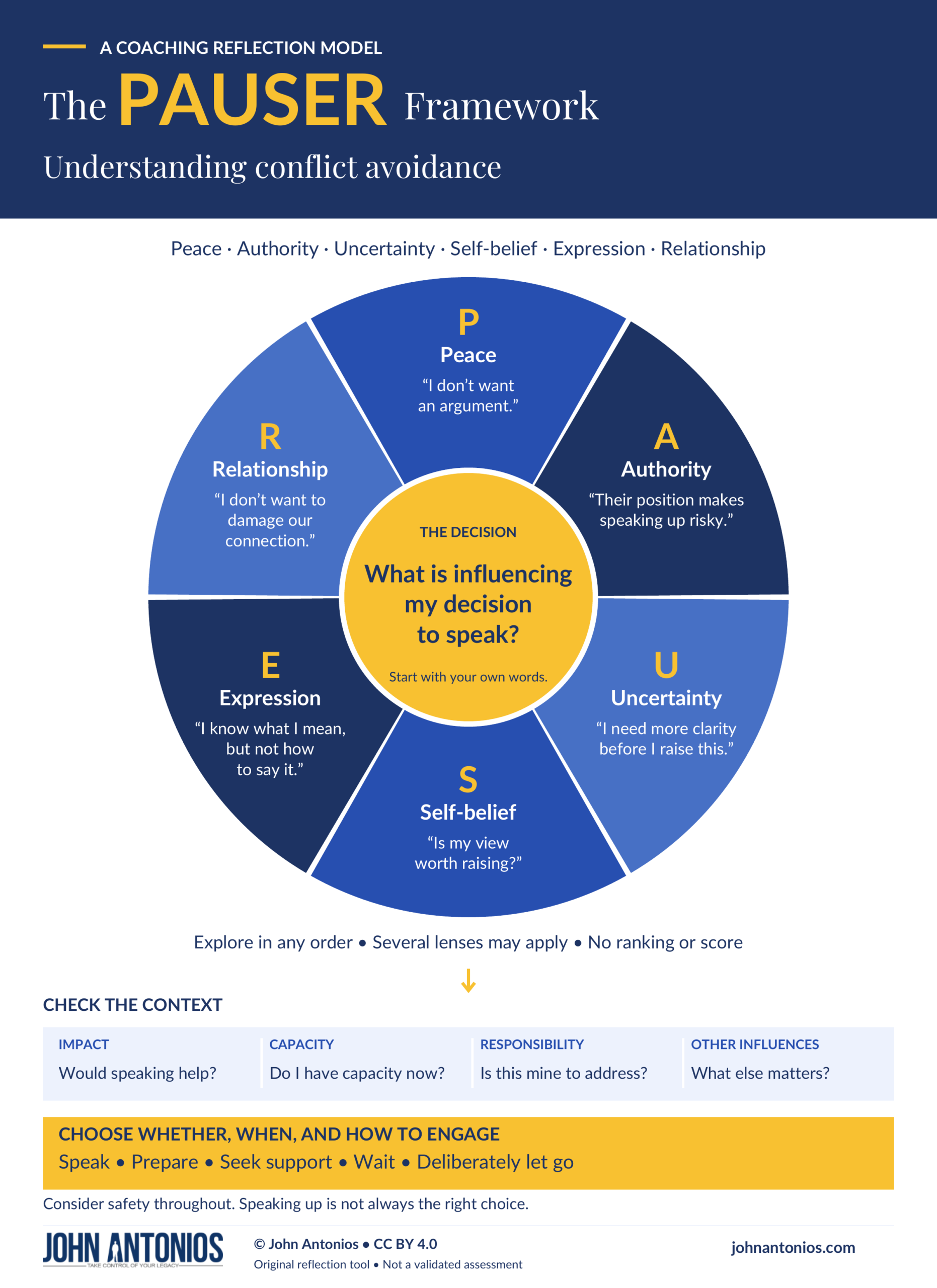
Use the infographic as a quick reference. The reflection worksheet takes you through one moment, your next step, and an optional comparison across situations. The coach’s guide adds definitions, follow-up questions, boundaries, and the worked example.
-
- Download the reflection worksheet (fillable and printable PDF).
-
- Download the coach’s guide (PDF).
You can read this article without downloading anything. Choose the resource that suits how you want to use the framework.
The model graphic is © John Antonios, licensed under Creative Commons Attribution 4.0 International. Credit John Antonios, link to the licence, and identify any changes when reusing it. That licence notice applies to the graphic; it does not extend to the accompanying article, worksheet, or guide. Referenced research remains subject to its own rights.
References
Milliken, F. J., Morrison, E. W., & Hewlin, P. F. (2003). An exploratory study of employee silence: Issues that employees don’t communicate upward and why. Journal of Management Studies, 40(6), 1453–1476. https://doi.org/10.1111/1467-6486.00387
Edmondson, A. (1999). Psychological safety and learning behavior in work teams. Administrative Science Quarterly, 44(2), 350–383. https://doi.org/10.2307/2666999
Ames, D. R., & Flynn, F. J. (2007). What breaks a leader: The curvilinear relation between assertiveness and leadership. Journal of Personality and Social Psychology, 92(2), 307–324. https://doi.org/10.1037/0022-3514.92.2.307